How to Read Your Birth Chart Without Feeling Overwhelmed
Learn how to read a birth chart step by step, from your Big Three and houses to aspects and transits, without turning astrology into a verdict.
# How to Read Your Birth Chart Without Feeling Overwhelmed
Opening a newly generated birth chart can feel like being handed a beautiful map in a language you have never studied. There are symbols, coloured lines, numbered sections, planets, signs and terms that seem to ask for your attention all at once. The good news is that a birth chart is not designed to be understood in one sitting.
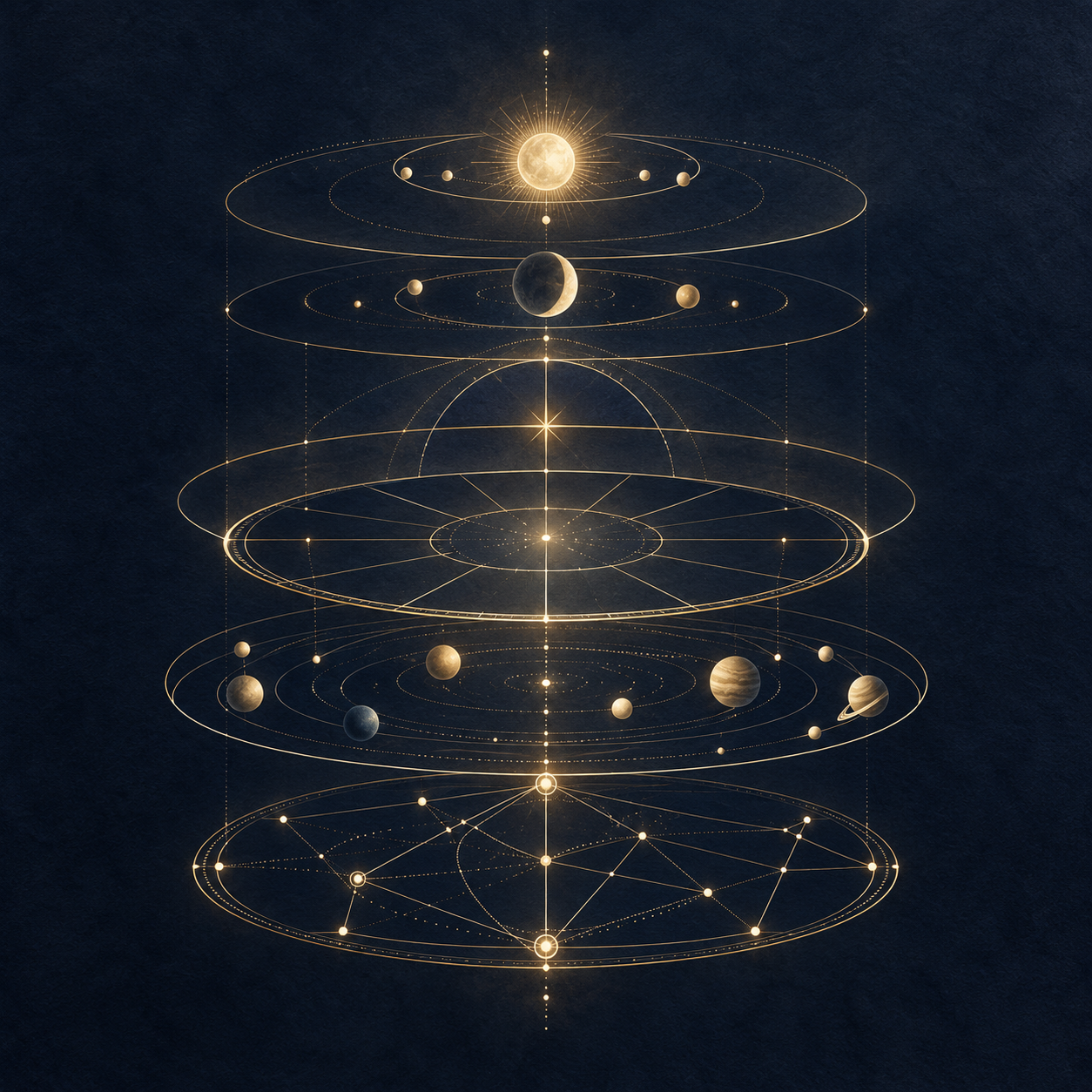
Think of it as a layered portrait rather than a test you need to pass. Each layer adds context: your inner needs, your outward approach, the areas of life that matter most, and the patterns you may return to over time. Astrology is most useful when it gives you better questions, not rigid answers. Start slowly, stay curious, and let the chart reveal itself in stages.
First, check the birth data
Before interpreting anything, look at the information used to create your chart: your birth date, birthplace and birth time. The date and location establish the positions of the planets. Your birth time is especially important because it helps calculate the Ascendant, also called the Rising sign, and the twelve houses.
The Ascendant is the sign rising on the eastern horizon at the moment of birth. It changes roughly every two hours, which is why even a small difference in recorded time can alter it. Houses are the twelve life areas in a chart, from identity and resources to friendships, work and private life. If the birth time is inaccurate, house placements and the Ascendant may be less reliable.
That does not make a chart without a known birth time useless. You can still explore the planets in signs, many aspects between planets, and broad emotional or developmental themes. Just avoid making firm claims about houses, the Ascendant or exact timing techniques until more reliable birth data is available.
Start with the Big Three
The “Big Three” refers to your Sun, Moon and Ascendant. They are a helpful opening point because each describes a different dimension of experience, not because they reduce you to three labels.
Your Sun points to the qualities you are learning to express consciously. It can describe your sense of purpose, vitality and the kind of contribution that feels personally meaningful. Rather than asking, “What am I supposed to be?” ask what helps you feel centred and fully engaged.
Your Moon speaks to your emotional rhythms: what helps you settle, process, restore and feel safe enough to be real. The Moon is often less about what others immediately notice and more about the conditions your inner life needs.
Your Ascendant describes your initial orientation to life. It influences how you meet new experiences, what people may first pick up from you, and the lens through which the rest of the chart is organised. It is not a mask or a performance; it is a starting posture.
Try these reflection questions before looking up long lists of meanings:
- When do I feel most purposeful and self-directed?
- What do I need when I am overwhelmed, disappointed or tired?
- How do I tend to approach unfamiliar people, places or opportunities?
Notice where the answers overlap and where they differ. A rich chart often contains contrasts, and those contrasts are not mistakes.
Find the chart ruler
Once you know your Ascendant, you can find your chart ruler. The chart ruler is the planet traditionally associated with the sign on your Ascendant. For example, an Aries Ascendant is ruled by Mars, a Taurus Ascendant by Venus, a Gemini Ascendant by Mercury, and a Cancer Ascendant by the Moon. For the remaining signs, use the traditional rulers: Leo–Sun, Virgo–Mercury, Libra–Venus, Scorpio–Mars, Sagittarius–Jupiter, Capricorn–Saturn, Aquarius–Saturn and Pisces–Jupiter.
The chart ruler is worth noticing because it can act like a recurring thread through the chart. Look at its sign, its house and its aspects. Its sign suggests the style in which that planet operates; its house shows the life area where its themes may be especially active; its aspects show how it connects with other parts of you.
Treat this as a second-pass clue, not a verdict about your personality. A chart ruler does not override every other placement. It simply offers a useful place to return when you want to understand how the chart’s different pieces might be linked.
Read planets in houses before memorising every sign
A simple framework can make a chart much easier to read: planet = what, sign = how, house = where.
A planet describes a function or drive. Venus relates to attraction, values, pleasure and reciprocity; Mercury relates to thought, language and perception; Mars relates to action, assertion and desire. The sign shows how that function tends to express itself. The house shows where in life you are most likely to meet that theme.
For example, imagine Mercury in Taurus in the sixth house. Mercury is the “what”: thinking, communicating and organising information. Taurus is the “how”: perhaps steadily, practically and with a preference for ideas that can be applied. The sixth house is the “where”: daily systems, work habits, skills, health routines or service. This does not mean the person is destined for one job or has one communication style forever. It suggests that practical thinking may become especially relevant in the way they structure everyday life.
This approach keeps interpretation grounded. Instead of trying to memorise hundreds of disconnected definitions, you can build a sentence from three clear parts and then compare it with lived experience.
Look at aspects as conversations, not grades
Aspects are the angles planets make to one another in a chart. They show relationships between different needs and drives. They are often described as “easy” or “hard,” but it is more helpful to think of them as conversations with different tones.
A conjunction happens when planets are close together. Their themes are blended, intensified or difficult to separate. A square creates friction that asks for movement, adjustment or skill-building. A trine suggests a natural flow between planets; it can feel supportive, though it may also be easy to take for granted. An opposition places two needs across from each other, inviting awareness, balance and perspective.
No aspect is automatically good or bad. A square can become a source of resilience and motivation. A trine can become more meaningful when used intentionally. Context matters: consider the planets involved, their signs and houses, and the overall chart pattern.
Also consider the orb, the amount of distance allowed from an exact aspect. A close aspect is generally felt more strongly than a wide one, but different astrologers use different orb ranges. Let precision support your reading, not make it anxious.
Use current transits only after the natal foundation
Your natal chart is the chart of the sky at your birth. It is your foundational symbolic map: the patterns, potentials and questions you begin with. A transit is the current movement of a planet through the sky as it interacts with your natal chart.
Transits can describe seasons of emphasis, reflection or change. They are not promises of events. Before looking at a daily forecast or a major upcoming transit, become familiar with your natal Sun, Moon, Ascendant, chart ruler and the houses that matter in the transit. Otherwise, it is easy to mistake a dramatic headline for personal insight.
A useful transit question is: “What part of my existing chart is being invited into awareness?” This keeps astrology connected to choice, timing and self-knowledge rather than prediction anxiety.
A 20-minute first-reading method
You do not need an evening of research to have a meaningful first encounter with your chart. Set a timer, keep a notebook nearby and use this six-step sequence.
1. Confirm your data. Check the date, place and birth time. If the time is uncertain, make a note not to rely heavily on houses or the Ascendant. 2. Write down your Big Three. Record the sign and house of your Sun and Moon, plus your Ascendant if your time is known. Add one real-life observation for each. 3. Identify your chart ruler. Find the ruler of your Ascendant, then note its sign, house and closest aspect. 4. Choose three planets. Start with Mercury, Venus and Mars. Read each using the planet-what, sign-how, house-where method. 5. Look for two or three close aspects. Name the planets involved and describe the relationship in plain language. Avoid interpreting every line on the chart at once. 6. End with one journal prompt. Try: “What pattern here feels familiar, and what would it look like to work with it more consciously?”
The goal is not to produce a final definition of yourself. It is to leave with a few observations that feel accurate, useful and worth revisiting.
What not to do with a birth chart
First, do not panic over a placement, house or aspect that is described online as difficult. Astrology language can become dramatic when it is stripped of context. A chart shows tensions and resources together, and no single symbol can measure your worth, happiness or capacity for change.
Second, do not outsource major choices to astrology. A chart can help you reflect on your values, fears and timing, but it cannot make your decisions for you. Use it alongside practical information, trusted support and your own judgment.
Third, do not treat one placement as the whole person. Saying “I have this sign, so I am this way” skips the complexity that makes astrology valuable. Your planets, houses, aspects, lived environment and choices all shape how a pattern is expressed.
FAQ
Do I need to know astrology to read my birth chart?
No. Begin with a few core concepts rather than trying to learn every symbol. The Big Three, houses, chart ruler and major aspects provide a strong foundation. You can deepen your knowledge over time by comparing interpretations with your actual experiences.
Can I read my chart if I do not know my birth time?
Yes. You can still explore planetary signs and many planet-to-planet aspects. However, the Ascendant and houses may change substantially across the day, so read those areas cautiously. If possible, check family records, official documents or ask relatives whether they remember the approximate time.
Why do parts of my chart seem contradictory?
Because people are complex. One placement may describe a need for privacy while another describes a desire to connect, or one aspect may show ease where another shows tension. These are not contradictions to eliminate; they are relationships to understand and navigate with greater choice.
If you would like a calmer, more personal place to begin, explore your natal chart reading, ask questions through Starfect astrology chat, or look at relationship dynamics with a compatibility reading. Start with curiosity. Your chart is not here to limit you; it is here to help you notice yourself more clearly.